
Your next customer just asked AI about you. What did it say?
Every day, ChatGPT, Gemini and Perplexity answer questions about your category in sentences you never see. That answer is your reputation now. The brand it names gets the call. Aeloria shows you the answer, tells you what to fix first, and asks the same questions again until the change is measured, not claimed.
Enter your brand and, if you like, your website. The button opens an email to our team, already filled in: add your geographic focus, send it, and we reply with the link to your free AI reputation assessment, no card needed. It gives you your score, Brand AURA, 0 to 100: an estimate of how likely a customer who asks AI is to find you and choose you, with the four KPIs behind it. The ranked list of what to fix comes with Leading, at €239 a month, and your first 30 days on it are free. Prefer a conversation? Request a live walkthrough on your brand →
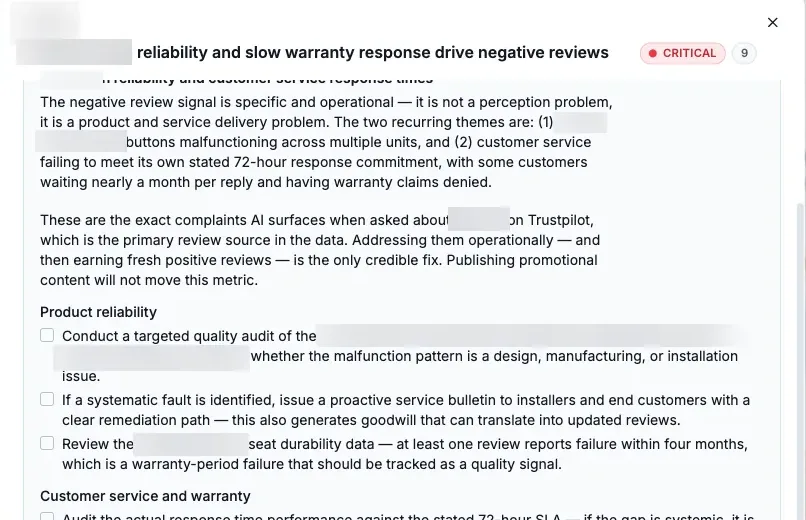
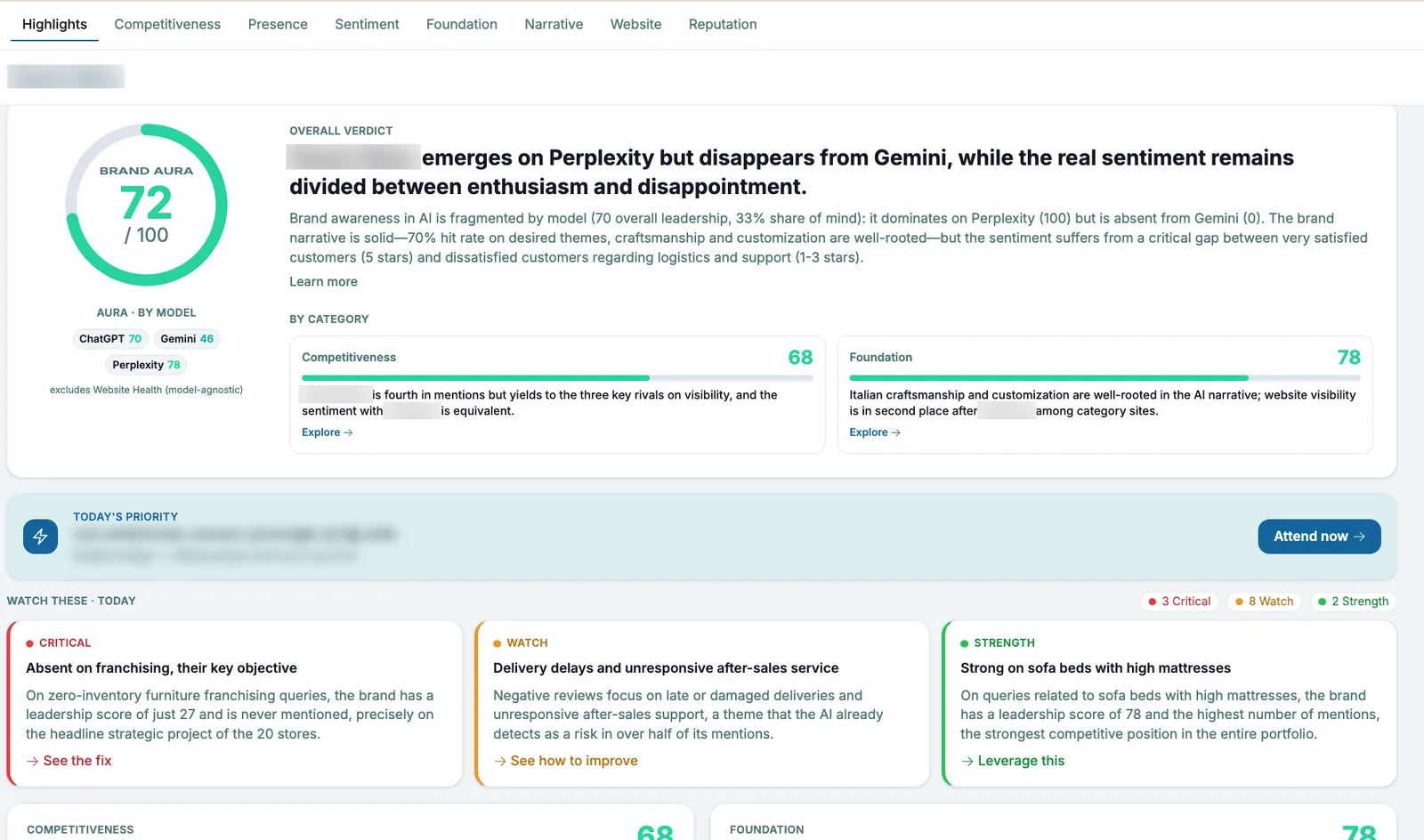
An illustrative report for a furniture brand: the scores, the risks and the fixes Aeloria surfaces. Free assessment by email; the fix list comes with Leading, and your first 30 days on it are free.
Trusted by the brands AI talks about, and the agencies behind them

 Leader in textile automation
  Leader in construction solutions
"As we support our clients from a strategic consulting perspective, AI visibility has become an increasingly important part of the conversation. We looked at several tools: most of them stop at monitoring and data collection. Then we discovered Aeloria. With Aeloria, we can go further: we get a clear snapshot and overview of all the brands we work with, visibility into key trends, and actionable recommendations that provide a solid starting point for our further strategic interpretation and development. This gives us a strong foundation on which to build our branding and communication expertise, combining data-driven insights with strategic consultancy to deliver greater value to our clients."
Menabò, Evolutionary Branding · Agency partner, ItalyOne number. One list. One proof.
Nothing new to learn before you get value. Everything opens to its evidence.
A score your board can read
Brand AURA, 0 to 100: how likely your next customer is to find you and choose you when they ask AI. It is built from four KPIs: Discoverability, whether AI names you at all; Narrative, the story it tells about you; Sentiment, how it judges you; and Reputation, the themes it attaches to your brand, positive or at risk. Your Website is scored alongside, for how well your own site feeds all four. Every part of it opens to the AI answers behind it. It moves, and you can see why, per engine, per market, per question.
A list of what to fix first
Ranked by what it will change against what it costs you. Every item quotes the AI answer that caused it, so nobody has to take our word for anything.
Proof that it worked
After you ship, we ask the same questions again, on schedule. Same prompts, same engines, same conditions. The difference is measured, not claimed.
Measure. Fix. Prove. Then again.
Your Monday starts with a ranked to-do list, not a dashboard to interpret.
We ask
Your buyers' real questions, written natively in each market you choose, run across engines.
You read
Your score, the answers behind it, and the exact place a competitor was named instead of you.
Your team ships
The top fixes go to whoever owns the page. Each one says exactly what to change, on your site and beyond it.
We ask again
Same questions, same engines. You see what moved, and what still needs work.
Every finding opens to its evidence.
A fix in Aeloria is never "improve your content". It is the sentence an engine lifted from a competitor, the page it took it from, the change that closes the gap, and one click that makes it a task for the person who owns that page. Fixes land where AI actually reads: your pages, listings, review platforms, the third-party sites it cites.
Analytics refresh on a regular schedule. The re-run uses the identical prompt set, so the before and after are like-for-like rather than a trend across a different period. Read the guide to improving AI visibility →
Built for the brand. Built for the agency that runs twenty.
One page written for both usually serves neither. Pick yours.
I run a brand
From a single-product company to a group selling in six languages.
- One brand, one score, and from Leading, one fix list
- Your rivals tracked on the same questions
- Your own site, audited the way an AI crawler reads it
- Your first score free, your first cycle of fixes free
I run an agency
New revenue from the clients you already bill, and a way into the ones you want next.
"Most of them stop at monitoring and data collection. Then we discovered Aeloria." Menabò, agency partner
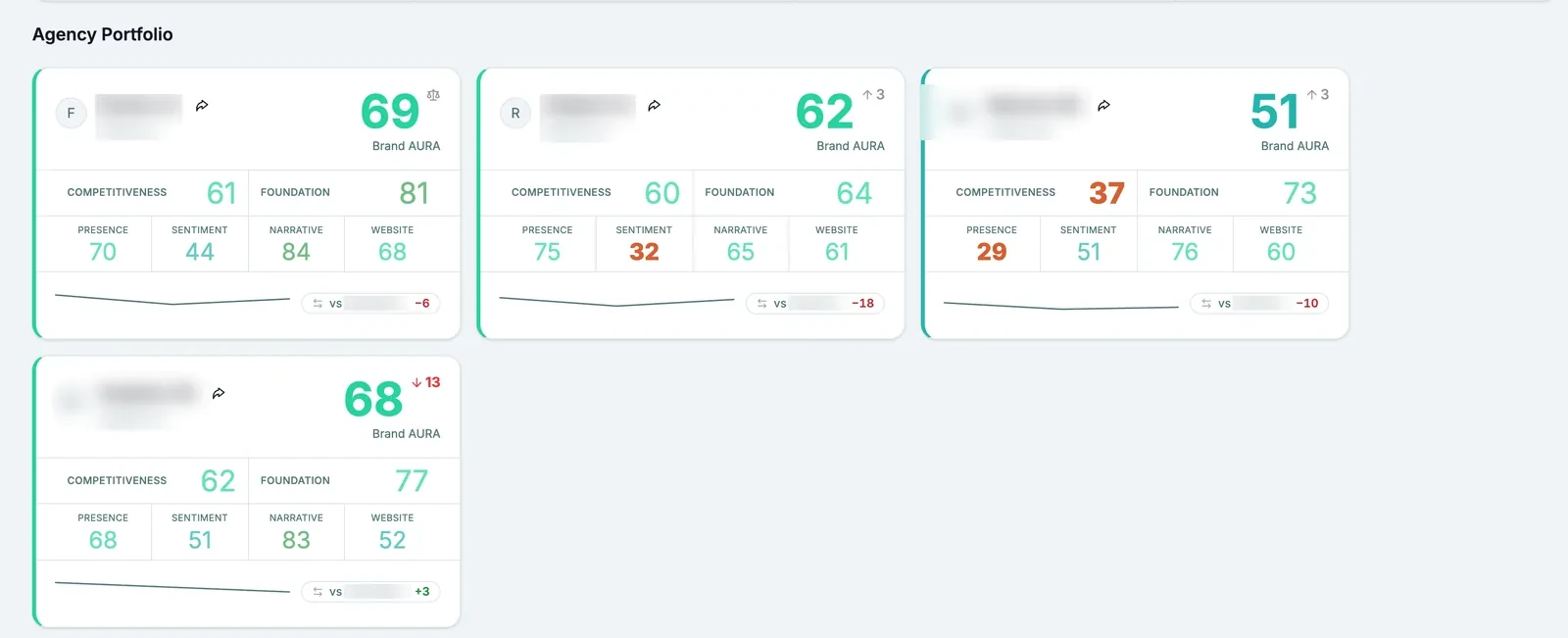
- Every client side by side in one cockpit: you see an account slipping before your client does
- Reports in your own branding, €99 a month flat for any number of brands
- Five Iconic-depth prospect audits a month: diagnose any brand from its name alone, before a contract or a call
- €719 a month with 3 brands, €199 per extra brand
Every price. Every limit. No surprises.
Three plans, three stages. Rising shows you where you stand. Leading guides you towards your strategic goals. Iconic adds the deepest analysis and the widest coverage, to make your brand iconic in the eyes of AI. Whatever your plan reads is inside its price: no engine is ever an add-on, nothing is metered.
Your baseline starts the day you do.
What AI said about you last month cannot be measured now. Every week before your first measurement is a week of movement you will never be able to prove.
Every subscription started in 2026 keeps this price for 24 months.
How the free cycle works. Your AI reputation assessment is free: one per brand, at Rising depth, no card. When you want the fix list, Leading runs free for 30 days; ship one fix in that time and the second cycle is free as well. Cancel before a free cycle ends and nothing is charged. Annual billing gives 2 months free, and limits are base values we can raise on request. Every tier, every limit, every number: the pricing page →
Watching is where the others stop.
Acting is where Aeloria starts.
The tools we are most often measured against are visibility trackers, strong at counting mentions. Aeloria acts on what it finds and proves what moved. Compared on public pricing and published documentation.
| Capability | Aeloria | Profound | Peec AI | Otterly.ai |
|---|---|---|---|---|
| One composite brand score (board-ready) | ✓ Brand AURA | ◐ visibility score | ◐ visibility score | ◐ visibility index |
| Ranked fix list scored on impact and effort | ✓ both | ◐ limited until Enterprise | ◐ impact only | ◐ impact only |
| Before/after re-measurement tied to each shipped fix | ✓ identical prompt set | ✗ not documented | ◐ impact after an action | ✗ not documented |
| A full cycle free, no card to start | ✓ 30 days of the full fix list | ◐ 7-day trial | ◐ free trial | ◐ 7-day trial, no card |
| Three AI assistants on the entry plan | ✓ ChatGPT, Gemini, Perplexity | ✗ no paid entry plan | ◐ choose 3 | ◐ 4, three more paid |
| Prompts written natively per market, not translated | ✓ any language, every plan | ✗ 1 below Enterprise | ◐ not documented | ✓ 65+ countries and languages |
| White-label agency reporting | ✓ native, +€99/mo flat | ◐ not documented | ◐ via Looker | ◐ via Looker |
| Every surface a plan reads is inside its published price | ✓ never an add-on | ✗ engines gated by tier | ✗ extra models cost extra | ✗ 3 engines sold separately |
Aeloria publishes this comparison and has a commercial interest in it. Based on each vendor's own public pages, checked 30 September 2026. Vendors change their products; if something here is out of date, tell us at contact@aeloria.ai and we will correct it. ✓ included · ◐ partial or tier-gated · ✗ not offered or not confirmed. Coverage scales by plan for all four vendors.
GEO is full of superstition.
We ship what survives the evidence.
We track the peer-reviewed research and the controlled experiments in this field, and grade every tactic before it enters our recommendation engine. The things we hold to be true:
An AI answer about your brand is a reputation you never got to read.
It can be measured. And what gets measured gets managed.
Every recommendation deserves a receipt. Ours quote the answer that caused them.
A fix you cannot prove is a fix you cannot bill for.
The next buyer may be an agent that never opens a website. The brands it will trust are the ones managing their reputation now. Read why →
Train your reputation.
What the evidence supports, so we weight it
- Informational density: quotable definitions, attributed statistics, structured comparisons and worked examples, the content shapes AI engines tend to lift.
- Retrieval and crawler access: making sure answer-time bots can reach, parse and extract your key pages, the layer most audits skip entirely.
- Third-party corroboration: most AI citations come from independent pages, listings and communities, not from the brand's own site. Fixes go where the engines look.
- Continuous re-measurement: one-off content tricks erode as competitors adopt them. The loop is the moat, not the trick.
What we won't sell you
- "Add this magic file and AI will cite you": the engines' own documentation says otherwise.
- Guaranteed citation uplifts quoted as universal percentages: the underlying studies do not support that promise, and we will not make it.
- Keyword stuffing and format tricks: measured at best as noise, at worst as actively harmful in modern LLM search pipelines.
- Black-box scores you cannot defend: every Aeloria signal opens to its quoted evidence.
AI answers cannot be gamed reliably. They can be measured precisely and earned systematically. Aeloria exists to make sure your budget flows only into the levers with evidence behind them, and to prove it moved something. That is the whole business.
We come from brand protection. This is the same problem in a new place.
I spent eight years building Authena, where brands prove their products are real. An AI answer is a counterfeit of a different kind: a confident story about your brand that you did not write, that your buyers hear every day, and that nobody can be called to correct.
That story is a reputation. It can be measured, and what gets measured gets managed. So we built the loop: measure what AI says, fix the sources it learns from, ask the same questions again, prove it moved.
Two rules we will not break. We tell you what we do not know. And we never sell you a number we cannot defend in front of your board. If you want to see it on your own brand before you decide, ask for a live walkthrough.

Swiss-based. EU hosting. A DPA that names names.
In Europe, data posture is a buying criterion, not a footnote. Here is ours, in the detail a procurement team asks for, with the documents to check it against.
Data, hosting and security: the detail your procurement team will ask for
Application, storage and compute on Google Cloud, in European regions. Aeloria is Swiss-based, registered in Rüschlikon in the canton of Zürich; Switzerland holds an EU adequacy decision, so data moves between the two without a workaround.
What we send to the AI engines are buyer questions about your category and brand. They never contain your customers' personal data, so the engines' operators are not sub-processors of it; the DPA names exactly who is.
Aligned to the GDPR and the Swiss revDSG. You are the controller for the brand data you configure; Aeloria is the processor. Transfers outside the EEA run on Standard Contractual Clauses, with the EU-US Data Privacy Framework where it applies.
Aeloria is a Swiss-based provider and processes data under Swiss and EU law. If your procurement requires a specific regional framework, tell us before you sign and we will confirm in writing what we can commit to.
Workspace content is kept for the subscription plus 30 days, with export tools open across that window; backups purge within 90 days; logs at 12 months. Billing records are held 10 years because Swiss commercial law requires it.
TLS 1.2+ in transit, AES-256 at rest. Salted password hashes, role-based access on least privilege, logging of administrative access to customer data, and dependency vulnerability scanning.
One documented answer a year. The DPA gives you Annex II, the security measures as actually implemented, plus our hosting provider's documentation, and commits us to answering a written security questionnaire once every twelve months.
Read it rather than take our word for it: Data Processing Agreement · Privacy Policy · Terms · Cookies.
What is Aeloria?
Aeloria is an AI reputation management platform, built in Zürich. Nobody outside a frontier lab trains the model itself, but every answer an AI gives about you is assembled from evidence it can find, and that evidence can be measured, corrected and measured again. That loop is reputation management. GEO and AEO are two tactics inside it; reputation is the whole surface. Aeloria measures how ChatGPT, Gemini and Perplexity describe, judge, cite and recommend your brand, converts every gap into a ranked, effort-scored fix list, and re-measures the identical prompt set after each fix ships. One composite Brand AURA score (0 to 100), an estimate of how likely a buyer who asks AI is to find and choose the brand, is built from four KPIs a board already understands: Discoverability, whether AI names you at all; Narrative, the story it tells about you; Sentiment, how it judges you; and Reputation, the themes it attaches to your brand, positive or at risk. Every part of it opens to the AI answers it came from. Most tools stop at watching. Aeloria closes the loop.
The questions people actually ask.
What is free, exactly?
Which AI engines do you measure?
Every plan reads the three assistants your buyers ask most: ChatGPT, Gemini and Perplexity, in the markets you choose, written natively rather than translated, sampled several times on every run, so the reading holds up when someone questions it. Iconic adds Microsoft Copilot and Google AI Mode, and Enterprise is configured around whatever your category actually runs on. Whatever your plan reads is inside its published price, and no engine ever appears as an extra line on your bill.
Can you fix things for me?
Where does my data live?
What is AI reputation management?
Can I cancel any time?
What if AI already says the right things about us?
How is Aeloria different from Profound, Peec AI or Otterly.ai?
It takes one line to find out.
Enter your brand, and your website if you like, send the email the button opens, and we reply with the link to your AI reputation assessment: your score, an estimate of how likely a customer who asks AI is to find you and choose you, with the four KPIs behind it. Then, when you want it, the ranked list of what to fix and the tools to act on it, free for a full 30-day cycle. The assessment costs nothing and needs no card. See what AI weighs. Know your number. Fix what pays.
No card, no sales call. The button opens an email to our team: add your geographic focus and send it.